Model Description
{{ctrl.selModel.name}}
A small office with 4 users, occupied 7am-7pm on weekdays. The total internal gains from equipment is set to 400W. The target illuminance level is 400 Lux. Heating and cooling are operational between 5am and 7pm during weekdays.
A classroom with 20 occupants, used from 7am to 6pm on weekdays during term time. The total internal gains from equipment is set to 400W. The target illuminance level is 280 Lux. Heating and cooling are operational between 5am and 6pm during weekdays.
Space as a single-occupant studio flat that is occupied 24/7. The total internal gains from equipment is set to 450W. The target illuminance level is 100 Lux. Heating and cooling are operational at all times.
A hotel room with two occupants, occupied during nighttime from 9pm to 9am. The total internal gains from equipment is set to 100W. The target illuminance level is 200 Lux. Heating and cooling are operational at all times.
General
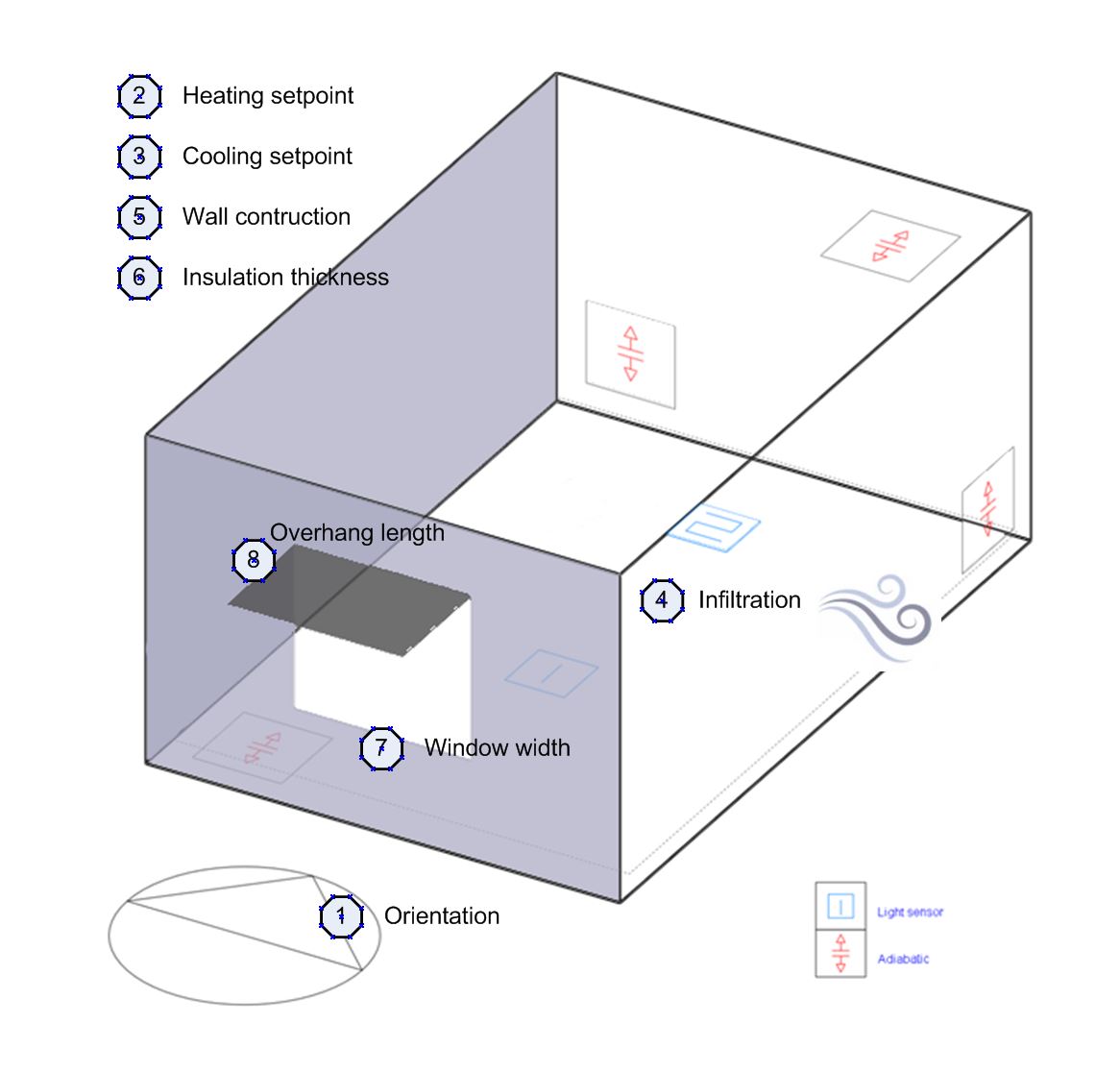
4m x 6m x 3m space with two external walls and one double-glazed window (U=1.9, not openable). All other surfaces are adiabatic (internal walls). The external wall construction and insulation are variables.
The space is assumed to be fully conditioned with variable heating and cooling setpoints. Occupancy and the associated schedules are defined for the corresponding space types. Mechanical ventilation to provide minimum fresh air requirement for the occupants at 10 l/s per occupant is included. Lighting is controlled by illuminance sensors. Energy efficiency of the light fittings is set to 2.5W per m² per 100 Lux at the worktop level.
The calculation of Carbon emissions is based on the assumption of gas heating and electrical cooling.
Annual consumption
| Heating [kWh] | Cooling [kWh] | Lighting [kWh] | Discomfort [hrs] |
|---|---|---|---|
| {{ctrl.kpi.heating}} | {{ctrl.kpi.cooling}} | {{ctrl.kpi.lighting}} | {{ctrl.kpi.discomfort}} |